


★★★★★ Excellent 4.8
E-book: The Kitchen Pharmacy: Home Remedies That Actually Work
E-book: The Kitchen Pharmacy: Home Remedies That Actually Work
🫚 12 ingredients. Already on your shelf.
⭐ 6 clinicians — PharmD, MD, RDN, CNM, EM-MD, Family MD
🚫 No monthly charges or hidden fees
🔒 14-day money-back guarantee
Couldn't load pickup availability
Description
Description
The ingredients are already on your shelf. This is what to do with them.
🫚 12 clinician-reviewed household practices: ginger, garlic, honey, thyme, oregano, turmeric, lemon, salt, baking soda, chamomile, peppermint, apple cider vinegar. One dose, one duration, one "don't use if" line, one threshold per ingredient.
🟢 The Green/Yellow/Red Safety Filter: every Action page carries the three-color decision indicator. Handle at home, watch with thresholds, or call a clinician now.
📋 The Kitchen Pharmacy Card: a printable single page designed to be folded and hung on the inside of the spice cabinet door. All four numbers for every ingredient, signed by the Panel.
🔢 Four numbers per ingredient: dose, duration, contraindication, threshold. Without the four numbers a home remedy is a guess. With them it is a household practice you can teach your children.
🚫 Seven cross-cutting safety guards: anaphylaxis, pregnancy modifications, anticoagulant interactions, gallstones, GERD, ragweed allergy, and the most important rule in the book: no honey under 12 months, ever.
💊 Drug interaction tables: every ingredient reviewed for interactions by E.S.P., PharmD. Named interactions for garlic, ginger, turmeric, and chamomile in households with anticoagulants.
🔖 13 chapters across 3 parts: from the Pantry Mindset through the Twelve ingredients to the Card, the Cabinet, and the Practice.
Researched, written, and reviewed in the United States. Signed by six licensed clinicians. Every pediatric dose signed by K.M.P., MD, FAAP. Every drug interaction table signed by E.S.P., PharmD. Every pregnancy caveat signed by A.J.K., CNM.
What's included
What's included
- 12 ingredient chapters with dose, duration, contraindication, and threshold for each
- The Green/Yellow/Red Safety Filter on every Action page
- Drug interaction tables reviewed by E.S.P., PharmD for all 12 ingredients
- Pregnancy and lactation caveats reviewed by A.J.K., CNM for every relevant ingredient
- Seven cross-cutting safety guards including the no-honey-under-12-months rule
- Printable Kitchen Pharmacy Card for the inside of the spice cabinet door
- Free downloadable bibliography with every primary source listed and linked
How to use
How to use
- Read the front matter: seven safety guards before the first ingredient chapter
- Read the guide cover to cover on a Saturday morning (about two hours)
- Print the Kitchen Pharmacy Card on page 64
- Fold it once and hang it inside the spice cabinet door
- Turn to the chapter when you need it, read the Action page, check the Safety Filter
- When the Threshold Line applies, stop home care and call the clinician
Our help & support center
Our help & support center
We are dedicated to ensuring your satisfaction. Our team is always available to assist you with any questions or issues you may have. Our goal is to help you grow your business and achieve success.
Support Email:helena.europetrip@gmail.com
14-Day Refund Policy
14-Day Refund Policy
We offer a 14-day refund policy.
If you are not satisfied with your purchase, you may request a refund within 14 days of the purchase date. To be eligible, you must contact our support team within this period and provide your order details.
Support team email: helena.europetrip@gmail.com
Refunds will be processed to the original payment method within a few business days after approval.
If you have any questions, our support team is here to help.


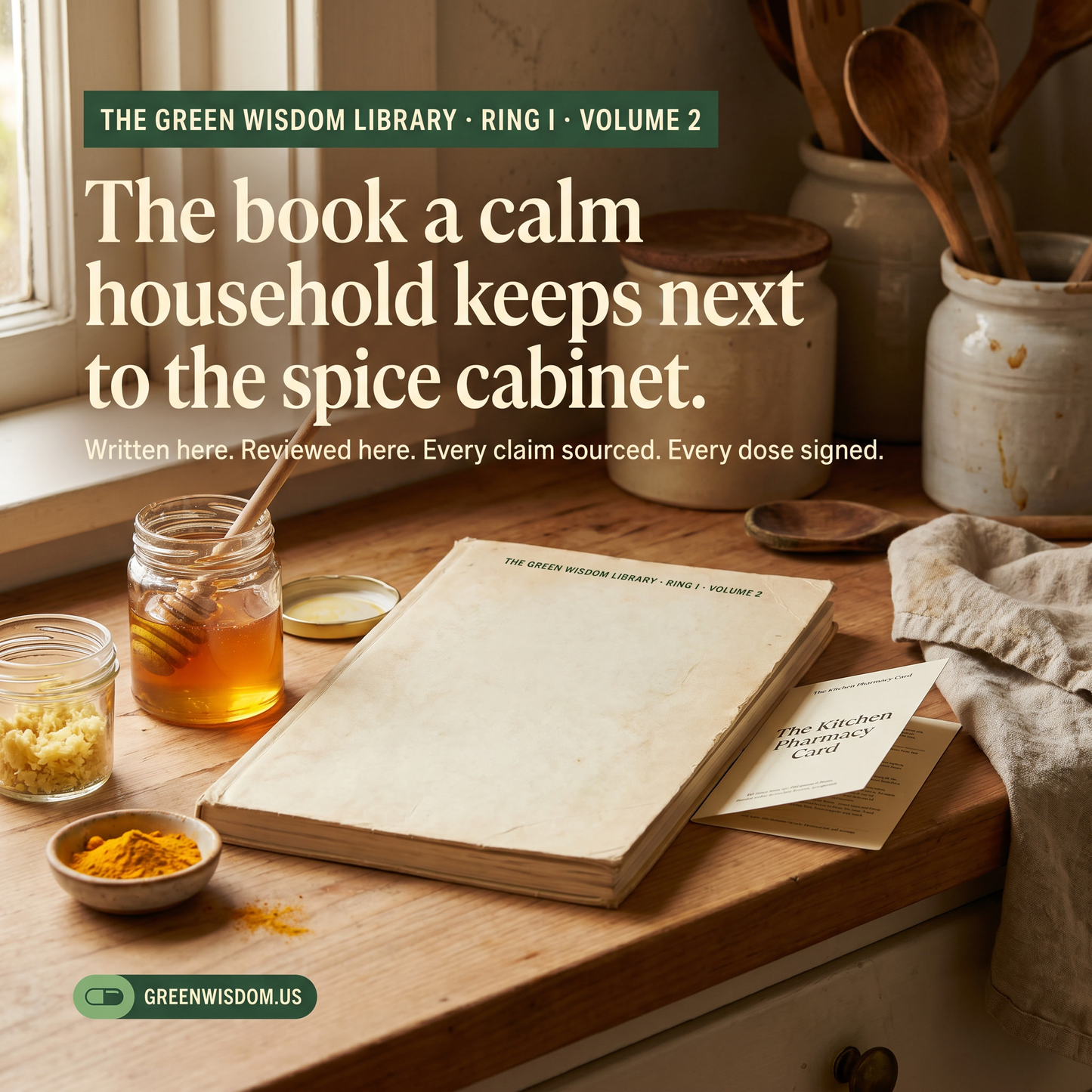

The ingredients are already on your shelf. This is what to do with them.
12 household practices. One dose, one duration, one contraindication, and one threshold for every ingredient. The book a calm American household keeps next to the spice cabinet.

I wrote this for the moment you stand at the spice cabinet
and can't remember the dose.
There is a moment every household has had. Someone you love says their stomach feels funny, or the cough that won't stop. You open the spice cabinet, you know ginger is supposed to help, and you cannot remember how much, for how long, or whether it is safe for the person in front of you. Without those four numbers, a home remedy is a guess. With them, it is a household practice you can teach your children.
This guide gives you all four numbers for twelve ingredients already on your shelf. Every dose is clinician-reviewed. Every drug interaction table is signed by E.S.P., PharmD. Every pregnancy caveat is signed by A.J.K., CNM. The Kitchen Pharmacy Card on page 64 folds once and hangs inside the spice cabinet door. That is the whole program.
Every drug interaction table signed by E.S.P., PharmD. Every pregnancy caveat signed by A.J.K., CNM. Every pediatric dose signed by K.M.P., MD, FAAP. License numbers published in the guide. Updates free, forever.
12 Ingredients. 4 Numbers Each.
One practice the household can teach its children.
Every chapter follows the CALM Method — Context, Action, Lookup, Mastery — and closes with the Threshold Line: the exact condition under which the kitchen stops and the clinician begins.
🫚 Ginger: The Queasy Stomach
A Cochrane meta-analysis of pregnancy-nausea trials established 1 g per day as the household dose. A quarter-inch slice simmered in one cup of water for ten minutes, four times daily. The anticoagulant interaction is the most important contraindication in this guide and is named on every Action page.
- Adult and pediatric doses with worked example
- Drug interactions: anticoagulants, antiplatelets, antidiabetics
- Pregnancy note: ACOG-endorsed at 250 mg four times daily, first trimester
🍯 Honey: The Nighttime Cough
The Cochrane meta-analysis updated through 2023 confirms honey reduces cough severity in children one year and older. Half a teaspoon for ages 1 to 5, one teaspoon for ages 6 to 11, thirty minutes before bed. The rule on the first page and on every page: never under 12 months, no exceptions, no sources.
- Dose by age: four bands from 1 year through adult
- AAP endorsement for children over 1 as safer alternative to OTC cough products
- Infant botulism rule: named, explained, repeated
🟡 Turmeric: The Daily Golden Spoon
Half a teaspoon in cooking with a pinch of black pepper. Not the supplement aisle. The FDA's adverse-event signal for high-dose enhanced-bioavailability curcumin supplements is named and explained. The spice cabinet dose is the practice; the supplement bottle requires a clinician conversation.
- Piperine bioavailability mechanism explained
- FDA hepatic-injury signal for enhanced-bioavailability supplements named
- Anticoagulant and iron-chelation interactions reviewed by ESP, PharmD
🫙 Oregano: An Honest Stop
The shortest chapter in the guide, on purpose. Oregano leaf in cooking is generous and safe. Oregano essential oil internally is not a household practice this guide endorses. The marketing claims outrun the clinical evidence. The German Commission E published a negative monograph. The guide stops where the evidence stops.
- AHPA Botanical Safety Handbook classification cited
- In-vitro vs clinical-translation gap named honestly
- Essential oil internal use: not endorsed, named reason given
🧄 Garlic: The Daily Clove
One fresh clove, crushed, rested ten minutes, added to food. A Cochrane review found a modest but real reduction in systolic blood pressure over 8 to 24 weeks. Not a substitute for prescribed antihypertensives. The warfarin interaction is named, the surgical-window rule is named, the HIV protease-inhibitor interaction is named.
- Allicin formation mechanism: crush, rest 10 minutes, then cook
- Drug interactions: anticoagulants, HIV protease inhibitors, oral contraceptives
- Fresh clove vs aged-garlic-extract supplement: different exposures, different conversations
+ 7 more ingredients inside
Thyme · Lemon · Salt · Baking Soda · Chamomile · Peppermint · Apple Cider Vinegar
Twelve ingredients.
Four numbers each. One card on the cabinet door.
Six tools, one guide. Built to be reopened in season, for years.
12 clinician-reviewed household practices
Dose, duration, contraindication, and threshold for every ingredient. Without the four numbers a home remedy is a guess. With them it is a practice you can teach your children.
One Action page per ingredientThe Green/Yellow/Red Safety Filter
Every Action page carries the three-color decision indicator. Handle at home, watch with thresholds, or call a clinician now. One bolded sentence at the bottom of every chapter: the Threshold Line.
On every Action page · every chapterThe Kitchen Pharmacy Card
A printable single page. All four numbers for all twelve ingredients, signed by the Panel. Fold it once. Hang it inside the spice cabinet door. The rest of the guide deepens what the Card already tells you.
One page · fold and hangDrug interaction tables
Every ingredient reviewed for drug interactions by E.S.P., PharmD. Named interactions for ginger, garlic, turmeric, and chamomile in households with anticoagulants. A "Don't use if" line on every Lookup page.
Reviewed by ESP, PharmD · every chapterPregnancy and lactation caveats
Five of the twelve ingredients have modified safety profiles in pregnancy. Every relevant chapter carries a pregnancy caveat signed by A.J.K., CNM. Culinary amounts are addressed separately from medicinal doses.
Reviewed by AJK, CNM · every relevant chapterFree downloadable bibliography
Every primary source listed and linked. Cochrane reviews, ACOG committee opinions, FDA communications, NIH-NCCIH fact sheets. Every claim that has a study has a footnote. Every claim without one is labeled as a traditional practice.
Free companion · always currentWhat the panel agreed on
cross-cutting safety guards on page one, before the first ingredient chapter
Saturday morning to read the guide and hang the Card inside the cabinet door
numbers per ingredient: the dose, the duration, the contraindication, the threshold
★ Verified Buyers · Real American Households
The Card is taped inside the cabinet door.
Here is what happened after.
Still have questions?
Here's everything you need to know.
Answers to the questions households ask before they buy.
Is this a substitute for my doctor or pharmacist?
No, and the guide says so on every page. Every chapter has a Threshold Line — a bolded sentence that tells you the exact condition under which you stop the kitchen practice and call a clinician. The guide is not a treatment. It is a household practice with four numbers per ingredient, a "Don't use if" line, and a clear boundary for when the kitchen stops and the clinician begins. The guide is built to help you make the call faster, not to replace the call.
Why only 12 ingredients? What about elderberry, echinacea, ashwagandha?
The twelve were chosen because they have the most credible evidence base for household use: Cochrane reviews, committee opinions from named organizations, or EMA traditional-use monographs with documented household traditions behind them. Elderberry, echinacea, and ashwagandha have smaller or more contested evidence bases, and the guide stopped where it could be honest. The Mastery section of each chapter explains the evidence behind that ingredient's inclusion. Nothing is included because it is popular; everything is included because it is supported.
My mother-in-law is on warfarin. Is any of this safe for her?
This is the most important question in the guide, and the drug interaction tables in Chapters 1, 2, 6, and 10 address it directly. Ginger, garlic, turmeric, and chamomile all have documented or theoretical interactions with anticoagulants at medicinal doses. Culinary amounts of all four are generally considered fine. The guide gives you the exact threshold between culinary and medicinal for each ingredient and tells you to bring it to her pharmacist before changing anything. The pharmacist conversation is built into the practice, not optional.
Is honey really safe for my one-year-old?
Yes, from exactly twelve months onward. Chapter 3 carries the infant-botulism rule on its first page, its Action page, and its Lookup table. The rule is absolute: no honey, of any kind, from any source, raw or pasteurized, manuka or supermarket, for any infant under twelve months. From twelve months onward, half a teaspoon at bedtime for the nighttime cough is endorsed by the AAP as a safer alternative to OTC cough and cold products for children in this age group.
I am pregnant. Can I use any of these?
Some, with care. Five of the twelve have modified safety profiles in pregnancy: ginger at high doses, turmeric at medicinal doses, peppermint essential oil at any dose, oregano essential oil at any dose, and chamomile at high doses. Culinary amounts of all five are generally compatible with pregnancy. Every relevant chapter carries a pregnancy caveat signed by A.J.K., CNM, our certified nurse-midwife. The guide consistently directs you to your obstetric clinician before any medicinal-dose practice during pregnancy, and that direction is not optional.
Do I need Volume 1 or Volume 3 to use this guide?
No. Volume 2 is complete as a standalone guide. The cross-references to Volumes 1 and 3 are in the text for readers who own them, but the Card, the doses, and the Threshold Lines all stand alone. A household that reads this guide and hangs the Card has the whole practice. A household that also owns Volume 1 will find the two guides build on each other: Volume 1 teaches the household when to call; Volume 2 furnishes the spice cabinet for the moments that do not require a call.
What is the refund policy?
14-day no-questions-asked refund. If the guide does not deliver what we promise, email us within 14 days and we will refund you in full. You keep the PDF.